
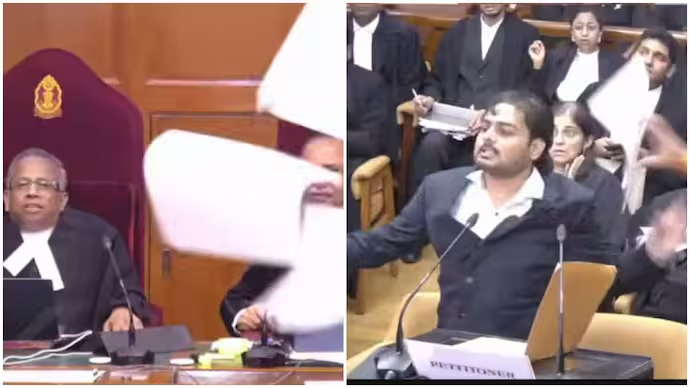
Supreme Court Courtroom Disruption: 5 Key Developments After Petitioner Throws Papers and Abuses Bench
A serious Supreme Court courtroom disruption was reported during the hearing of a petition challenging an order of the Allahabad High Court. A petitioner appearing without an advocate allegedly threw documents inside the courtroom and used abusive and unparliamentary language while addressing the Bench.
The incident occurred before a Bench comprising Justice K.V. Viswanathan and Justice Alok Aradhe.
Security personnel intervened and removed the petitioner from the courtroom. Despite the disruption, the Supreme Court reportedly decided not to initiate any separate action against him and proceeded to examine the petition on its merits.
Petitioner Appeared in Person Before Supreme Court
The petitioner, identified as Prabal Pratap, was appearing as a petitioner-in-person on behalf of both petitioners in the matter.
A petitioner-in-person is someone who chooses to present and argue a case before the court without being represented by an advocate. Although litigants are permitted to appear personally, they are still expected to follow courtroom procedure, maintain decorum and address the judges respectfully.
According to the report, the petitioner began his submissions by referring to the judges as “judicial servants” and purportedly attempted to direct the Bench to order the registration of an FIR against an Assistant Commissioner of Police in Lucknow.
The unusual manner of addressing the court reportedly prompted Justice Viswanathan to question whether the petitioner was attempting to issue an order to the Bench.
Supreme Court Courtroom Disruption Escalates
The exchange soon escalated into a wider Supreme Court courtroom disruption.
The petitioner allegedly threw his case papers into the air and used abusive language. Certain remarks were also reportedly directed against the Chief Justice of India, even though the Chief Justice was not part of the Bench hearing the matter.
Court security personnel immediately intervened and escorted the petitioner out of the courtroom.
The judges reportedly remained composed and did not engage with the outburst. Court proceedings resumed after order was restored.
Courtroom decorum is essential to the administration of justice. Litigants are entitled to present their grievances strongly, but threats, abuse, intimidation or disorderly conduct may interfere with judicial proceedings and can potentially attract contempt or other legal consequences.
Bench Records Incoherent and Unparliamentary Remarks
In its order, the Supreme Court reportedly noted that the petitioner did not proceed with a proper presentation of his case.
The Bench recorded that the petitioner-in-person made remarks that were incoherent and unparliamentary instead of addressing the legal grounds raised in the petition.
The expression “unparliamentary” is generally used for language that is abusive, offensive, undignified or unsuitable for formal proceedings.
However, the Court appears to have considered the petitioner’s condition before deciding how to respond to the incident.
Supreme Court Declines to Take Action Against Petitioner
Despite the Supreme Court courtroom disruption, the Bench adopted a lenient approach and declined to initiate further proceedings against the petitioner.
The order reportedly stated that, considering his condition, the Court did not propose to take any action against him.
This was significant because conduct involving abuse of judges, disturbance of proceedings or the throwing of documents can ordinarily be viewed seriously. Courts possess powers to maintain discipline and protect the dignity of judicial proceedings.
The Bench nevertheless exercised restraint in the particular circumstances of the case.
The decision not to initiate action should not be understood as general permission for litigants to behave similarly. It appears to have been a case-specific exercise of judicial discretion.
Petition Dismissed on Merits
After dealing with the courtroom incident, the Supreme Court examined the case record and considered the challenge against the Allahabad High Court order.
The Bench reportedly found no sufficient ground to interfere with the judgment under challenge.
The petition was therefore not entertained on merits.
This means that the Supreme Court’s refusal was not based only on the petitioner’s conduct. The judges also reviewed the case papers and independently concluded that the High Court’s order did not require interference.
When the Supreme Court hears a challenge to a High Court order, it does not automatically reconsider every factual and legal issue. The petitioner must demonstrate a substantial error, illegality, procedural unfairness or another compelling ground requiring the Court’s intervention.
Why Courtroom Decorum Matters
The incident highlights the responsibilities of individuals who appear before constitutional courts without legal representation.
A petitioner-in-person has the right to be heard, but must:
- Address the judges respectfully
- Confine submissions to relevant facts and legal grounds
- Follow directions issued by the Bench
- Avoid personal allegations and abusive language
- Refrain from interrupting judicial proceedings
- Maintain the dignity of the courtroom
Strong disagreement with a judicial order does not justify misconduct inside the court.
A party who is dissatisfied with an order may pursue the legal remedies available under law, including review, appeal or other appropriate proceedings. Courtroom aggression cannot replace legal arguments.
Key Takeaway
The Supreme Court courtroom disruption resulted in the petitioner being removed by security personnel after he allegedly threw papers and used abusive language.
The Bench recorded his conduct but chose not to initiate further action, considering the surrounding circumstances. The Court nevertheless examined the petition and found no reason to interfere with the Allahabad High Court’s order.
The incident serves as a reminder that access to justice includes a corresponding duty to respect judicial institutions and follow proper courtroom procedure.