
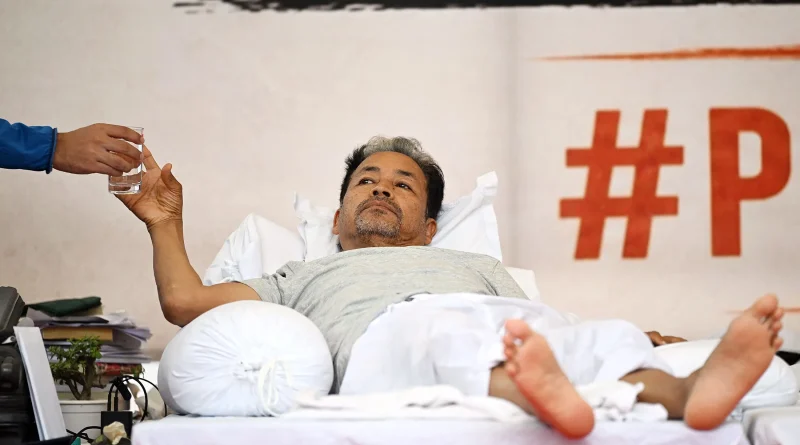
Sonam Wangchuk Hunger Strike: 5 Urgent Developments as Delhi High Court Hears Medical Plea
The Sonam Wangchuk hunger strike has reached the Delhi High Court after an urgent public interest petition raised serious concerns about the activist’s deteriorating health.
The petition claims that Wangchuk may not survive for more than a few days without immediate medical assistance. It has asked the court to direct the authorities to shift him to a government hospital and provide essential nutrition under medical supervision.
The Delhi High Court has agreed to hear the matter urgently and is expected to consider whether intervention is required to protect Wangchuk’s life while respecting his right to continue a peaceful protest.
1. Sonam Wangchuk Hunger Strike Reaches Delhi High Court
A public interest litigation has been filed before the Delhi High Court seeking urgent medical intervention in connection with the Sonam Wangchuk hunger strike.
According to the petition, Wangchuk has been fasting indefinitely since June 28 and has reportedly lost around 8.5 kilograms. The petitioner has expressed concern that his physical condition may worsen rapidly unless the authorities take immediate action.
The plea argues that the government cannot remain a silent observer when the life of a citizen is believed to be in danger.
It has requested that Wangchuk be taken to a government hospital, where doctors can assess his health and provide necessary nutrients, vitamins and minerals through a medically appropriate liquid diet.
2. Court Lists the Matter for Urgent Hearing
The matter came before a Division Bench comprising Chief Justice D.K. Upadhyaya and Justice Tejas Karia.
The court deferred the hearing after noting that no representative appeared on behalf of the concerned authorities. Their absence was reportedly connected to an ongoing work abstention by the Delhi High Court Bar Association.
However, considering the urgency described in the petition, the Bench directed that the matter be taken up the following day.
The court also indicated that the Union Government and other concerned authorities would be required to obtain instructions. The registry was directed to communicate the order to them without delay.
This means that the Sonam Wangchuk hunger strike case could receive an immediate response from the government during the next hearing.
3. Plea Seeks Medical Intervention and Force-Feeding
The petition has been filed by advocate Rakesh Kumar Saini.
It seeks directions for the authorities to shift Wangchuk to a government medical facility. The petitioner has also suggested that essential nutrition may be administered even without his consent if doctors believe it is necessary to save his life.
Force-feeding is a legally and ethically sensitive issue. Courts generally have to balance several competing considerations, including:
- The individual’s personal autonomy
- The right to peaceful protest
- The State’s responsibility to protect life
- Medical opinion regarding the immediate risk to health
The petition argues that allowing the Sonam Wangchuk hunger strike to continue without medical supervision could result in irreversible consequences.
The court has not yet passed any final direction requiring force-feeding. It will first hear the parties and examine the circumstances surrounding the protest and Wangchuk’s medical condition.
4. Petition Refers to the Right to Peaceful Protest
The petitioner has maintained that peacefully protesting at a public place is an important democratic right.
Under the Indian constitutional framework, citizens enjoy freedom of speech and expression as well as the right to assemble peacefully, subject to reasonable restrictions.
At the same time, the petition argues that the right to protest does not remove the State’s responsibility to protect the life and safety of a protester.
The plea alleges that the authorities have been insensitive to Wangchuk’s deteriorating condition. It claims that the activist should not be treated as a criminal merely because he is participating in a public protest.
The petitioner has therefore asked the court to ensure that the right to protest is protected while necessary steps are taken to prevent loss of life.
Readers may also refer to our detailed explainer on the constitutional right to peaceful protest in India.
5. Protest Reportedly Linked to NEET Controversy
The Sonam Wangchuk hunger strike is reportedly connected to demands concerning alleged irregularities in the NEET examination.
According to the petition, Wangchuk is demanding the resignation of Union Education Minister Dharmendra Pradhan over the controversy.
He reportedly joined demonstrations organised by the Cockroach Janta Party, which describes itself as a youth-led political platform.
The petition claims that the issue affects a large number of students and raises wider questions about education, examination transparency and government accountability.
However, the Delhi High Court proceedings presently appear to be focused primarily on Wangchuk’s health and whether urgent medical intervention is required.
What Will the Delhi High Court Decide?
During the next hearing, the Delhi High Court may seek responses from the Union Government, the Delhi Government and other concerned authorities.
The court may consider:
- Wangchuk’s latest medical condition
- Whether doctors have examined him
- Whether hospitalisation is immediately necessary
- Whether nutrition can legally be administered without consent
- How to balance personal autonomy with the right to life
- Whether the authorities have taken sufficient preventive measures
The final decision will depend on medical evidence, the government’s response and the legal submissions made before the Bench.
For the moment, the Sonam Wangchuk hunger strike remains a developing matter. The Delhi High Court’s next order could determine whether the authorities must arrange immediate hospitalisation or provide any other form of medical protection.