
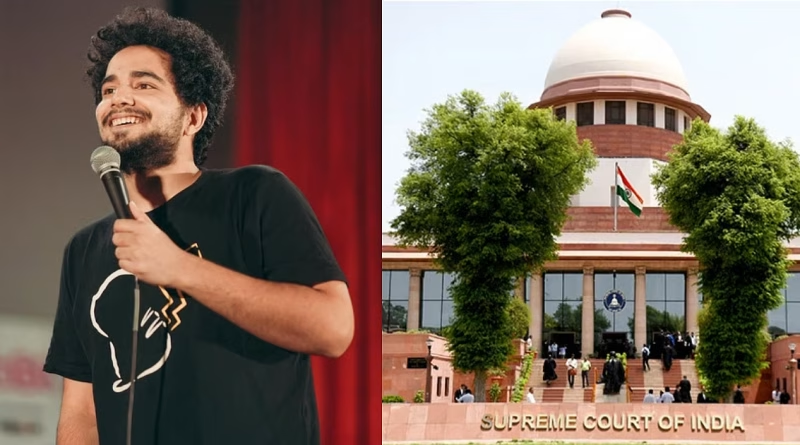
Samay Raina Supreme Court Fine: 5 Key Points as Court Imposes ₹3 Lakh Cost
The Samay Raina Supreme Court fine matter has drawn attention after the Court imposed costs of ₹3 lakh each on the stand-up comedian and four other individuals for allegedly failing to comply with its earlier directions concerning persons with disabilities.
The case arose from proceedings relating to allegedly insensitive remarks made about persons with disabilities during online comedy content. The Supreme Court had previously issued directions requiring the concerned individuals to organise fundraising events and involve persons with disabilities in those programmes.
During the latest hearing, the Court was informed that Samay Raina had reportedly not invited any person with a disability to participate in his shows, despite the earlier direction.
A Bench comprising Chief Justice of India Surya Kant, Justice Joymalya Bagchi and Justice V. Mohana took a serious view of the alleged non-compliance.
1. Why Was the Samay Raina Supreme Court Fine Imposed?
The Samay Raina Supreme Court fine was imposed after the Bench was told that the comedian had not followed a specific direction requiring the participation of persons with disabilities in the events organised pursuant to the Court’s earlier order.
The proceedings originated from a petition filed by Cure SMA India Foundation. The organisation had objected to remarks concerning the cost of treatment for Spinal Muscular Atrophy and alleged ridicule of a person affected by the condition.
Spinal Muscular Atrophy is a serious genetic disorder that affects muscles and movement. Treatment can be extremely expensive, making comments about the condition particularly sensitive for affected individuals and their families.
The petition reportedly sought broader safeguards concerning online content that may violate the dignity and rights of persons with disabilities.
2. Court Questions Compliance With Earlier Directions
The Supreme Court had earlier directed the concerned comedians and content creators to organise regular events for raising funds for a corpus intended to support persons with disabilities.
They were also reportedly directed to make efforts to involve specially-abled persons in those programmes.
During the hearing, Senior Advocate Aparajita Singh, appearing for the petitioner organisation, submitted that Samay Raina had neither approached the organisation nor invited persons with disabilities to participate in his shows.
Raina’s counsel informed the Court that approximately ₹9 lakh had been raised through the events.
However, the petitioner’s counsel stated that the organisation was not seeking money from the individuals concerned. The central grievance was reportedly about inclusion, sensitivity and compliance with the Court’s direction.
3. Supreme Court Raises Right to Dignity
The Bench questioned whether merely raising funds could be treated as sufficient compliance when the previous direction also required meaningful participation by persons with disabilities.
The Court reportedly observed that the concerned individuals should have invited representatives or members associated with the petitioner organisation to the events.
It also raised an important constitutional concern regarding the dignity of persons with disabilities.
The Bench indicated that when performers invoke freedom of speech or commercial expression, they must also recognise that persons with disabilities enjoy an equally important fundamental right to dignity.
The case therefore involves a balance between:
- Freedom of speech and expression
- Commercial and creative freedom
- Accountability for harmful or insensitive content
- The dignity of persons with disabilities
- Compliance with binding judicial directions
The Samay Raina Supreme Court fine reflects the Court’s concern that remedial directions must be followed in substance and not merely through symbolic action.
4. Court Says It Was Taken for a Ride
The Supreme Court reportedly expressed dissatisfaction with the manner in which compliance was presented before it.
The Bench observed that it had reason to believe that the Court had been taken for a ride and that its previous directions had been openly violated.
The Court was also informed that an affidavit had allegedly been filed concerning compliance. However, the Bench reportedly found that no such affidavit was available on the record.
This further aggravated the Court’s concern and contributed to its decision to impose monetary costs.
Courts expect parties to provide complete and accurate information regarding compliance with judicial orders. Any incorrect statement about documents, affidavits or actions taken may be viewed seriously.
5. ₹3 Lakh Cost Imposed on Each Person
The Supreme Court ultimately imposed costs of ₹3 lakh each on Samay Raina and four others.
The amount was directed to be deposited within two weeks.
According to the report, the Bench initially considered imposing a higher cost of ₹10 lakh on each individual but later reduced it to ₹3 lakh.
The Court also directed the individuals to comply with its previous directions.
It warned that continued non-compliance could lead to significantly higher financial consequences. The Bench reportedly indicated that the amount could rise to ₹30 lakh if the directions remained unfulfilled.
The order therefore serves both as a penalty for alleged past non-compliance and a warning regarding future conduct.
What Was the Original Case About?
The proceedings relate to allegations that comments made during online comedy content were insensitive towards persons with disabilities.
The petition filed by Cure SMA India Foundation reportedly raised concerns over remarks about the high cost of treatment for Spinal Muscular Atrophy.
It also sought regulatory measures for online broadcasts that may affect the constitutional right to life and dignity of persons with disabilities.
The case has broader significance because digital creators today reach millions of viewers. Courts may therefore examine whether popular online content crosses the boundary between permissible humour and speech that humiliates vulnerable groups.
Does Freedom of Speech Protect Comedy?
Article 19(1)(a) of the Constitution protects freedom of speech and expression. This protection extends to artistic expression, satire, criticism and comedy.
However, the right is not absolute.
Speech may be subject to reasonable restrictions under Article 19(2), and courts may also consider other constitutional protections, including the right to life and dignity under Article 21.
Comedy may involve exaggeration, discomfort or criticism, but content targeting a person’s disability can raise questions about discrimination, dignity and social responsibility.
The Court’s focus in the present matter appears to be not only on the original remarks but also on whether its remedial directions were honestly and fully followed.
Why Compliance With Court Orders Matters
A judicial direction remains binding unless it is modified, stayed or set aside by a competent court.
Parties cannot decide for themselves which portion of an order they will follow. Partial compliance may not be sufficient where the order contains multiple obligations.
In the Samay Raina Supreme Court fine case, raising funds was reportedly only one part of the required action. The direction concerning the participation of persons with disabilities was also expected to be followed.
Failure to comply with a court order may lead to:
- Monetary costs
- Contempt proceedings
- Additional directions
- Personal appearance
- Adverse judicial observations
- Higher penalties for continued default
Key Takeaway
The Samay Raina Supreme Court fine of ₹3 lakh each was imposed after the Court found apparent non-compliance with its earlier directions concerning persons with disabilities.
Although the Court was informed that funds had been raised through shows, it questioned why persons with disabilities were not invited to participate as previously directed.
The proceedings highlight that judicial compliance must be genuine and complete. They also underline the need to balance creative expression with the constitutional dignity of persons with disabilities.