
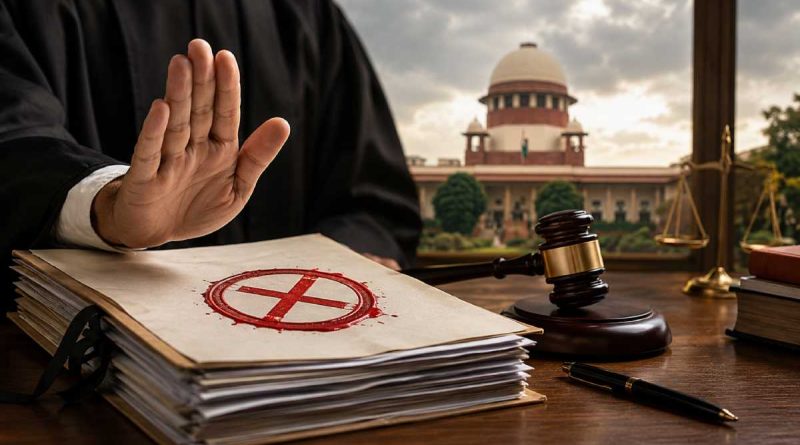
Quashing an FIR in India: When Can the High Court Kill a Criminal Case Before Trial?
The police have registered an FIR. Your name appears as an accused. Calls from the investigating officer have started. Arrest, bail, charge sheet and trial suddenly feel dangerously real.
Then someone says:
“Don’t worry. We will simply get the FIR quashed.”
But can an FIR really be erased so easily?
No.
Quashing an FIR is an extraordinary remedy. It is not a routine shortcut, an automatic consequence of settlement or a substitute for defending the case at trial.
A High Court may quash an FIR when continuing the criminal case would serve no legitimate purpose, where the allegations do not disclose an offence, where the prosecution is legally barred or where the criminal machinery is being abused.
However, the High Court will generally refuse to conduct a mini-trial or decide disputed evidence while hearing a quashing petition.
The difference between a strong quashing case and a weak one often depends on one question:
Even if every allegation in the FIR is accepted as true, does it disclose a legally prosecutable criminal offence?
What Does Quashing an FIR Mean?
Quashing means setting aside the FIR and, where applicable, the criminal proceedings arising from it.
Once the competent High Court quashes the FIR, the investigation or prosecution covered by the order comes to an end against the concerned petitioner.
Depending on the stage of the case, the petition may seek quashing of:
- The FIR
- The criminal complaint
- The charge sheet or police report
- The summoning order
- The order taking cognisance
- The entire criminal proceedings
- Proceedings against only some of the accused
- Particular offences added to the case
Quashing should not be confused with cancellation of an FIR by the police.
The investigating agency may file a closure or cancellation report where it concludes that no case is made out. But where an accused directly seeks judicial termination of the criminal case, the petition is ordinarily moved before the jurisdictional High Court.
Which Law Governs FIR Quashing in India?
The principal statutory provision is Section 528 of the Bharatiya Nagarik Suraksha Sanhita, 2023.
Section 528 preserves the inherent powers of the High Court to pass orders necessary:
- To give effect to an order under the BNSS
- To prevent abuse of the process of any court
- To otherwise secure the ends of justice
The BNSS came into force on 1 July 2024. Section 528 broadly corresponds to the earlier Section 482 of the Code of Criminal Procedure, 1973.
High Courts may also exercise writ jurisdiction under Article 226 of the Constitution of India in appropriate cases.
The correct legal route can depend upon:
- The date of the FIR
- The stage of investigation
- Whether a charge sheet has been filed
- Whether cognisance has been taken
- The nature of relief sought
- Transitional provisions applicable to older proceedings
A petition is therefore often titled under Section 528 BNSS, Article 226 of the Constitution or both, depending upon the circumstances.
Can a Sessions Court Quash an FIR?
Ordinarily, no.
The inherent power preserved under Section 528 BNSS belongs to the High Court.
A Sessions Court or Magistrate may exercise powers available under the procedural law at different stages, such as bail, discharge, rejection of a complaint or acquittal. However, these remedies are legally different from quashing an FIR through the High Court’s inherent jurisdiction.
This distinction matters.
An accused cannot simply file an “FIR quashing application” before the trial court and expect the FIR to be cancelled.
When Can an FIR Be Quashed?
The most frequently cited principles come from the Supreme Court’s decision in State of Haryana v. Bhajan Lal.
The Court identified illustrative situations in which criminal proceedings may be quashed. These are guidelines, not a rigid checklist.
An FIR may be considered for quashing in circumstances such as the following.
1. The FIR Does Not Disclose Any Offence
Suppose the entire FIR is read exactly as written.
Even then, if the essential ingredients of the alleged offence are missing, the High Court may intervene.
For example, every breach of contract is not cheating.
To constitute cheating, the allegations must ordinarily indicate dishonest or fraudulent intention at the relevant time. A later failure to repay money or fulfil a commercial promise does not automatically turn the dispute into a criminal offence.
Similarly:
- A property dispute is not automatically criminal trespass
- Non-payment of money is not automatically criminal breach of trust
- A failed business transaction is not automatically fraud
- A matrimonial disagreement is not automatically cruelty by every relative
- A defamatory statement is not automatically every offence cited in the FIR
The High Court examines whether the factual allegations satisfy the legal ingredients of the invoked offences.
It does not quash merely because the accused denies the allegations.
2. The Allegations Are Absurd or Inherently Improbable
The court may intervene where the allegations are so improbable that no reasonable person could conclude that there are sufficient grounds to proceed.
This does not mean that every unusual allegation will be rejected.
The improbability must emerge from the FIR, admitted documents or legally unimpeachable material. The court will usually avoid choosing between two competing factual stories at the quashing stage.
3. The Criminal Case Is Legally Barred
An FIR or prosecution may be challenged where a specific legal prohibition prevents the proceedings from continuing.
Examples may include:
- Absence of legally required sanction
- A statutory bar on prosecution
- Proceedings initiated beyond a mandatory legal limitation, where applicable
- Lack of jurisdiction
- Prosecution prohibited by a binding legal provision
- A complaint filed by a person not authorised under a special statute
The precise effect of such a defect depends upon the statute and the stage at which the objection is raised.
4. The FIR Is a Malicious Abuse of Criminal Law
The High Court may quash proceedings where the criminal case appears to have been initiated maliciously for vengeance or to exert pressure in a private dispute.
Common allegations of misuse arise in:
- Partnership disputes
- Loan recovery conflicts
- Landlord-tenant disagreements
- Property possession disputes
- Matrimonial litigation
- Family inheritance disputes
- Employer-employee conflicts
- Failed commercial transactions
However, merely describing the FIR as “false”, “motivated” or “a counterblast” is not enough.
The petition must demonstrate the abuse through the FIR, chronology, admitted records, earlier litigation or other reliable material.
5. The Parties Have Genuinely Settled the Dispute
A High Court may quash criminal proceedings arising from disputes that are overwhelmingly private or personal in nature when the parties have voluntarily settled their differences.
Typical examples may include:
- Matrimonial disputes
- Certain family conflicts
- Private financial disagreements
- Partnership disputes
- Some property-related conflicts
- Minor altercations
- Personal disputes without serious public consequences
But settlement does not create an absolute right to quashing.
The High Court considers:
- The nature and gravity of the offence
- Whether the dispute is genuinely private
- The impact on society
- The conduct of the accused
- Whether the settlement is voluntary
- Whether coercion or money pressure is involved
- The stage of the proceedings
- The likelihood of conviction after settlement
- Whether continuing the case would serve any meaningful purpose
Can Non-Compoundable Offences Be Quashed After Settlement?
Yes, in appropriate cases.
This is one of the most misunderstood areas of criminal law.
Compounding and quashing are not the same thing.
Compounding is governed by the statutory provision identifying offences that the parties may formally compromise, with or without the court’s permission.
Quashing is an exercise of the High Court’s extraordinary inherent jurisdiction.
Therefore, even where an offence is technically non-compoundable, the High Court may quash the proceedings if the dispute is substantially private and the broader interests of justice support closure.
But this principle does not mean that every non-compoundable case can be privately settled and erased.
Which Cases Are Normally Not Quashed Merely Because of Compromise?
Courts are generally reluctant to quash grave offences having a serious impact on society.
These may include:
- Murder
- Rape and serious sexual offences
- Terrorism
- Dacoity
- Offences against children
- Serious organised crime
- Corruption involving public servants
- Offences with major public consequences
- Heinous violence
- Serious economic offences affecting the public or financial system
A victim cannot necessarily neutralise a serious public offence by stating that the matter has been settled.
Criminal law protects society, not merely the individual complainant.
The High Court must therefore distinguish a private dispute carrying a criminal colour from an offence that strikes at public safety, institutional integrity or social order.
Can an FIR Under Section 498A Be Quashed After Settlement?
Yes, matrimonial FIRs are frequently quashed after a complete and voluntary settlement.
A typical settlement may address:
- Divorce by mutual consent
- Permanent alimony
- Return of jewellery and articles
- Child custody
- Visitation
- Withdrawal of domestic violence proceedings
- Withdrawal of maintenance cases
- Pending civil or criminal complaints
- Payment schedule
- No further claims between the parties
The High Court normally verifies whether the complainant has entered the settlement voluntarily.
The complainant may be required to appear before the court, physically or through an approved virtual mode, and confirm that there is no objection to quashing.
However, a vague compromise that leaves major disputes unresolved may not be sufficient.
The settlement terms should be precise, complete and capable of performance.
Can an FIR Be Quashed Without the Complainant’s Consent?
Yes.
Consent of the complainant is helpful in settlement-based quashing, but it is not required in every quashing case.
Where the FIR does not disclose an offence, is legally barred or clearly amounts to an abuse of process, the High Court may quash it despite opposition from the complainant.
For example, a complainant cannot preserve a legally defective prosecution merely by refusing consent.
Likewise, the State’s opposition does not prevent the High Court from examining whether continuation of the case is legally justified.
Can the Complainant Withdraw an FIR at the Police Station?
A complainant cannot simply take back an FIR as though it were a private application.
Once information disclosing a cognisable offence is formally registered, the criminal process is set in motion.
The complainant may:
- Give a statement regarding settlement
- Cooperate with a cancellation report
- File an affidavit of no objection
- Join a quashing petition
- Seek compounding where legally permissible
- Inform the investigating officer of relevant developments
But the FIR does not automatically vanish because the complainant signs a letter saying, “I withdraw my complaint.”
A court order or legally recognised closure process is generally required.
Can the Police Cancel an FIR?
The police can investigate and, where no prosecutable case is found, submit an appropriate closure or cancellation report before the Magistrate.
The Magistrate may:
- Accept the closure report
- Reject it
- Direct further investigation
- Take cognisance despite the police conclusion, where legally permissible
- Hear the complainant before accepting closure
A police closure report and a High Court quashing order are different remedies.
A closure report is based on the investigating agency’s findings. Quashing involves judicial review by the High Court under its inherent or constitutional jurisdiction.
Can an FIR Be Quashed Before Investigation Is Complete?
Yes, but High Courts exercise caution.
Early intervention may be justified where the legal defect is apparent from the FIR itself.
For instance, where the admitted allegations do not constitute any offence, requiring the accused to undergo a prolonged investigation may itself become an abuse of process.
On the other hand, where the truth depends upon:
- Witness statements
- Forensic examination
- Recovery of documents
- Financial tracing
- Electronic evidence
- Medical evidence
- Disputed intention
- Conflicting factual claims
the High Court may allow the investigation to continue.
Quashing jurisdiction is not intended to prevent every investigation merely because the accused claims innocence.
Can an FIR Be Quashed After a Charge Sheet Is Filed?
Yes.
Filing of a charge sheet does not automatically make a quashing petition impossible.
The relief must be framed according to the stage of the proceedings. The petitioner may seek quashing of:
- The FIR
- The charge sheet
- The cognisance order
- The summoning order
- All consequential proceedings
In a 2026 decision, the Supreme Court observed in the context before it that so long as cognisance had not been taken, a writ or order could be issued to quash the FIR or charge sheet under Article 226. The precise procedural route remains dependent on the facts and stage of each case.
The Supreme Court has also directly considered whether proceedings may be quashed after filing of a charge sheet, confirming that the stage of filing does not by itself extinguish the High Court’s jurisdiction.
Can Proceedings Be Quashed After Cognisance or Summoning?
Yes, in an appropriate case.
A petitioner may challenge the FIR together with the charge sheet, cognisance order and summoning order.
However, the petition must specifically identify the orders and proceedings sought to be quashed.
Where a trial court has already considered the police report and summoned the accused, the High Court may closely examine whether the petition is raising a genuine legal defect or merely seeking premature evaluation of the defence.
Can Only One Accused Get the FIR Quashed?
Yes.
Criminal proceedings may be quashed against one or more accused while continuing against others.
This commonly occurs where:
- No specific role is attributed to a particular relative or director
- An accused was not connected with the transaction
- Allegations against one person are general and omnibus
- Documentary records conclusively exclude a person’s involvement
- The settlement covers only particular accused
- The ingredients of the offence are absent against some but not all accused
The Supreme Court has dealt with proceedings where relief was granted to some accused but denied to others, reinforcing that the role of each accused must be examined individually.
Will the High Court Examine Evidence in a Quashing Petition?
Only to a limited extent.
The High Court does not ordinarily conduct a trial inside the quashing proceedings.
It generally does not:
- Decide which witness is truthful
- Compare disputed signatures
- Assess cross-examination
- Determine final guilt or innocence
- Resolve complex factual controversies
- Accept a contested defence as conclusively proved
The Supreme Court reiterated in February 2026 that the power under Section 528 BNSS at the FIR-quashing stage cannot be used to conduct a mini-trial.
At the same time, the court is not always required to shut its eyes to unimpeachable documents.
Material of sterling and undisputed quality may be considered where it completely destroys the prosecution’s foundation and does not require detailed evidence.
Examples may include:
- Official government records
- Uncontested public documents
- Judicial orders
- Registered instruments
- Admitted correspondence
- Records conclusively showing absence from the relevant place
- Documents relied upon by the prosecution itself
Whether a document is sufficiently reliable for consideration depends on the facts.
What Is the Test Applied by the High Court?
At the initial stage, the High Court commonly asks:
If the allegations are taken at face value, do they disclose the commission of a cognisable offence?
The court is not normally required to decide whether the allegations will ultimately result in conviction.
The Supreme Court stated in a 2025 decision that while considering a prayer to quash an FIR, the court examines whether the allegations disclose a cognisable offence, rather than conducting a merits determination of the case.
This is why a quashing petition must be legally focused.
Arguments such as “I am innocent”, “the complainant is lying” or “my evidence is stronger” may belong to investigation, discharge or trial unless supported by a clear legal defect.
How Is an FIR Quashing Petition Filed?
The petition is filed before the High Court having territorial jurisdiction over the FIR or criminal proceedings.
The broad process may include:
1. Obtaining the Complete Case Record
The advocate should examine:
- FIR
- Complaint
- Relevant police notices
- Arrest or bail orders
- Charge sheet, if filed
- Cognisance or summoning order
- Settlement deed, if any
- Connected civil or matrimonial proceedings
- Documentary record supporting quashing
2. Identifying the Correct Ground
A petition should not mix weak factual denials with strong legal grounds.
The principal basis may be:
- No offence disclosed
- Predominantly civil dispute
- Settlement between parties
- Legal bar to prosecution
- Mala fide prosecution
- Lack of specific allegations
- Unexplained implication of relatives or officials
- Abuse of criminal procedure
- Documentary impossibility
- Territorial or statutory defect
3. Preparing the Petition
The petition commonly contains:
- Case synopsis
- List of dates
- Parties’ details
- FIR particulars
- Factual background
- Grounds for quashing
- Relevant statutory provisions
- Judicial precedents
- Interim prayer
- Final prayer
- Affidavit
- Annexures
4. Making the State and Complainant Parties
The State is ordinarily impleaded through the appropriate authority.
The complainant or victim is generally made a respondent, especially in settlement-based matters.
5. Filing and Listing
After scrutiny and removal of filing objections, the matter is listed before the appropriate criminal bench.
The High Court may issue notice to:
- The State
- Investigating officer
- Complainant
- Other affected parties
6. Verification of Settlement
In compromise-based matters, the court may direct the parties to appear before:
- The High Court
- The investigating officer
- The trial court
- A Registrar or designated judicial officer
The authority may verify:
- Identity of the parties
- Voluntary nature of settlement
- Status of investigation
- Number of accused
- Whether any accused is absconding
- Whether any other case is pending
- Whether the complainant has any objection
7. Final Hearing
The High Court may:
- Quash the FIR and proceedings
- Dismiss the petition
- Issue notice and seek a status report
- Direct further verification
- Grant limited interim protection
- Quash proceedings against selected accused
- Impose costs or conditions
- Record undertakings
What Documents Are Usually Required?
The documents depend on the case, but commonly include:
- Copy of FIR
- Copy of complaint
- Identity proofs
- Charge sheet, if filed
- Cognisance or summoning order
- Bail orders
- Settlement agreement
- Affidavit of complainant
- Memorandum of understanding
- Divorce decree or mutual-consent statements
- Payment receipts
- Proof of return of articles
- Connected court orders
- Relevant contracts or property papers
- Police notices
- Translation of vernacular documents
- Index, synopsis and list of dates
- Vakalatnama
- Supporting affidavit
The settlement document should clearly mention the FIR number, police station, invoked offences and complete obligations of each side.
Does the Complainant Have to Appear in the High Court?
Frequently, yes, especially where quashing is sought on the basis of compromise.
The court may want to personally confirm that:
- The complainant understands the settlement
- Consent is voluntary
- No threat or pressure has been used
- The agreed payment has been received or secured
- There is no objection to quashing
- No undisclosed claim remains
Personal appearance may sometimes be exempted or facilitated through video conferencing, depending on the High Court’s directions and the facts.
A no-objection affidavit alone may not always be treated as sufficient.
Can the High Court Impose Costs While Quashing an FIR?
Yes.
Costs may be imposed to:
- Discourage misuse of criminal proceedings
- Account for public resources consumed
- Support a welfare fund
- Reflect delayed settlement
- Address conduct of the parties
- Balance the exercise of extraordinary jurisdiction
Payment of costs does not mean that a person can purchase quashing in every case.
The court first decides whether quashing is legally permissible. Costs may then be imposed as a condition.
Does Filing a Quashing Petition Stop Arrest?
No.
Filing the petition does not automatically stay investigation or protect the accused from arrest.
A specific interim order is required.
The petitioner may separately seek:
- No coercive action
- Stay of arrest
- Stay of further proceedings
- Exemption from personal appearance
- Protection for a limited period
- Direction to join investigation
High Courts are cautious about granting blanket orders that indefinitely restrain lawful investigation.
Where arrest is reasonably feared, anticipatory bail may need to be considered separately. A quashing petition should not be treated as a guaranteed substitute for bail.
Quashing, Discharge and Acquittal: What Is the Difference?
Quashing
The High Court terminates the FIR or proceedings through inherent or constitutional jurisdiction.
It may occur before or after filing of the charge sheet.
Discharge
The trial court releases the accused from the case before the full trial where the statutory requirements for framing charges are not met.
Discharge is based on the record available at the relevant procedural stage.
Acquittal
Acquittal ordinarily follows a trial or legally recognised conclusion where the accused is found not guilty.
These remedies operate at different stages and under different legal tests.
A case unsuitable for quashing may still be suitable for discharge. A case unsuitable for discharge may ultimately result in acquittal after evidence.
Common Reasons Quashing Petitions Fail
“The FIR Is False” Is the Only Argument
A bare denial creates a factual dispute. It does not establish a legal ground for quashing.
The Petition Asks the High Court to Decide Evidence
Quashing jurisdiction is not meant for detailed assessment of witnesses, disputed documents or forensic material.
The Settlement Is Incomplete
If payment remains due, connected cases remain pending or major claims are unresolved, the court may postpone or refuse quashing.
The Offence Is Too Serious
A private compromise may not outweigh the social impact of a grave offence.
Material Facts Are Concealed
Failure to disclose earlier petitions, bail orders, proclamation proceedings, charge sheets or connected litigation can seriously damage credibility.
Only the FIR Is Challenged Despite Later Orders
Where a charge sheet, cognisance order or summoning order has already been passed, the prayer must address the consequential proceedings as well.
The Wrong High Court Is Approached
Jurisdiction ordinarily follows the place where the FIR was registered and the cause of action arose, subject to constitutional principles.
The Petitioner Is Absconding
A person evading investigation or declared a proclaimed offender may face greater difficulty in seeking discretionary relief, particularly in settlement matters.
Can a False FIR Be Quashed Immediately?
Potentially, but “false” must mean more than disputed.
The strongest early quashing cases usually show that:
- No offence is disclosed even if allegations are accepted
- The prosecution is barred by law
- An undisputed document makes the allegation impossible
- The accused has been implicated without any specific role
- The FIR is a transparent attempt to criminalise a civil claim
- The complaint contradicts admitted judicial or official records
Where the alleged falsity depends upon witnesses, electronic evidence or disputed events, the High Court may allow the investigation to proceed.
Can a Civil Dispute and Criminal Case Continue Together?
Yes.
The existence of a civil remedy does not automatically prevent criminal prosecution.
A transaction may give rise to both:
- Civil liability, such as recovery of money
- Criminal liability, such as cheating or breach of trust
The key issue is whether the necessary criminal ingredients are actually alleged.
The High Court may quash where criminal terminology has been artificially added to pressurise the opposite party in a purely civil dispute.
But it will not quash merely because a civil suit could also have been filed.
Can Domestic Violence Proceedings Be Quashed Under Section 528 BNSS?
The Supreme Court held in May 2025 that High Courts may exercise jurisdiction under Section 482 CrPC, corresponding to Section 528 BNSS, in relation to proceedings arising from an application under Section 12(1) of the Protection of Women from Domestic Violence Act, 2005.
The Court also cautioned that this power must be exercised carefully, keeping the protective purpose of the Domestic Violence Act in view.
This means that the existence of a domestic violence proceeding does not completely exclude the High Court’s inherent jurisdiction, but quashing remains exceptional.
Can the High Court Review Its Own Quashing Order?
Ordinarily, a criminal court cannot review or materially alter its final judgment except as permitted by law.
The Supreme Court has examined the relationship between Section 528 BNSS and the statutory prohibition against review of criminal judgments. The inherent jurisdiction cannot routinely be used to reopen a final order merely because one party wants a different outcome.
Any challenge to a final High Court order may require an appeal or special leave petition before the Supreme Court, subject to legal maintainability.
How Long Does FIR Quashing Take?
There is no fixed nationwide timeline.
The duration depends on:
- High Court workload
- Filing defects
- Service upon respondents
- State’s status report
- Presence of the investigating officer
- Verification of settlement
- Stage of investigation
- Complexity of the allegations
- Whether connected cases must first be resolved
- Availability of all parties
A properly drafted, uncontested settlement matter may move more smoothly than a contested petition involving extensive records.
No advocate can ethically guarantee a specific result merely because the parties have compromised.
Is Quashing the Same as Proving Innocence?
Not always.
An FIR may be quashed because:
- The allegations do not legally constitute an offence
- The parties have settled a private dispute
- Continuing the case would be an abuse of process
- A statutory bar applies
- The prosecution has become futile
In a settlement-based quashing order, the High Court may not make a final declaration that every allegation was false.
The practical result is termination of the criminal proceedings, but the legal reasoning may differ from an acquittal after a full trial.
Frequently Asked Questions
Can an FIR be quashed before arrest?
Yes. Arrest is not a prerequisite for filing a quashing petition.
Can an FIR be quashed while anticipatory bail is pending?
Yes, the remedies can operate separately. The court may consider each petition under its own legal test.
Can an FIR be quashed if the complainant refuses to compromise?
Yes, where an independent legal ground for quashing exists. Compromise is not the only basis for relief.
Can the accused and complainant jointly file for quashing?
The accused usually files the principal petition, while the complainant may support it through an affidavit, appearance or joint application, depending on High Court practice.
Can an FIR be quashed after the trial has started?
Potentially, yes. But the court will examine the advanced stage of the proceedings and whether inherent jurisdiction should still be exercised.
Can an FIR against company directors be quashed?
Yes, where a director has been implicated without a specific role or where the applicable offence does not permit automatic vicarious liability. The result depends on the statutory provision and allegations.
Can an FIR be partly quashed?
Yes. The High Court may quash particular offences, proceedings against selected accused or a severable part of the prosecution.
Is the complainant’s affidavit enough for quashing?
Not always. The court may require personal verification and confirmation from the State or investigating officer.
Can quashing be rejected even after full settlement?
Yes. The court may refuse where the offence is grave, affects society, involves serious violence or where the settlement appears involuntary or legally inappropriate.
Can the Supreme Court quash an FIR?
The Supreme Court may exercise its constitutional powers in appropriate proceedings, but an FIR-quashing petition is ordinarily first moved before the jurisdictional High Court.
The Bottom Line
Quashing an FIR is not about convincing the High Court that the accused has a better story.
It is about demonstrating that the criminal case should not legally continue.
A strong petition usually answers four questions clearly:
- What exactly does the FIR allege?
- Which essential ingredient of the offence is missing?
- Why would continued investigation or prosecution amount to injustice or abuse?
- What undisputed material supports that conclusion?
Where a genuine private settlement has resolved the dispute, the High Court may bring the prosecution to an end.
Where the allegations disclose a serious offence requiring evidence, the court may refuse to interfere and allow the criminal process to take its course.
The power under Section 528 BNSS is wide, but it is deliberately used with caution.
It exists to prevent injustice, not to provide every accused with an early escape from investigation.